Citation graphs vs backlink graphs: what each one tells you.
Backlinks are not obsolete, and AI citations are not backlinks with a new name. They are different graphs answering different questions. Knowing which question you are asking decides which graph you need.
What does a backlink graph measure?
Backlink tools like Ahrefs, Semrush and Moz map the link structure of the web: who links to your domain, the estimated authority of those linkers, anchor text, and link gains and losses over time. This graph fed PageRank-style ranking and still informs how traditional search discovers and weighs sites.
That remains real. Links help crawlers find pages, and link-based authority still participates in how search engines rank; a business competing for organic Google rankings has legitimate reasons to watch its link profile. Declaring backlinks obsolete is as wrong as pretending they answer AI-visibility questions.
What does an AI citation graph measure?
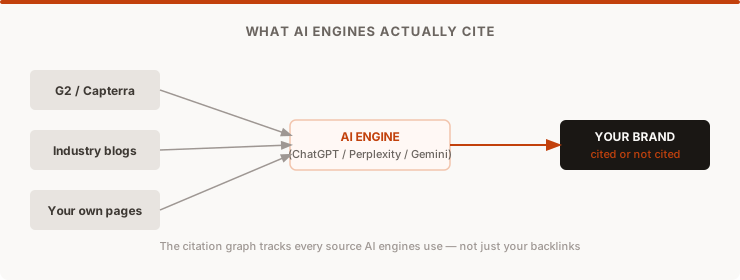
An AI citation graph is built from answers, not links: for each tracked buyer question, which URLs each engine cited, classified by what they are (your site, competitor sites, review platforms, directories, communities, editorial pages), and observed over time. Its nodes are the pages actually doing the deciding in AI answers.
The two graphs can disagree completely, and the disagreement is the insight. A high-authority domain by backlink measures may never appear in the citations for your questions; a modest community thread may be cited constantly. Only one of those facts is visible in a backlink tool.
Why do the two graphs answer different questions?
Because the systems consuming them make different judgments. Link-based authority is a domain-level, question-agnostic signal accumulated over years. AI answer generation selects supporting sources per question, favoring pages that directly support the sentences being generated, and mixing in independent sources like reviews and threads regardless of their link profiles.
So the backlink graph answers "how strong is this domain on the link-based web", while the citation graph answers "which specific pages does each engine trust for this specific question". For AI visibility, the second is the operative question; the mechanics of that selection are covered in how AI engines choose sources.
What can you do with a citation graph that you cannot do with backlinks?
Three concrete moves:
- Target real sources, not authority abstractions. The graph names the exact review platforms, directories, articles and threads cited for your questions, turning "build authority" into "earn presence on these named pages". The legitimate playbook for that is in third-party proof.
- See competitor evidence per question. For each lost question, the graph shows which cited sources mention competitors but not you, which is the actual gap deciding the answer.
- Track whether off-site work changed outcomes. Because the graph is anchored to questions, you can re-test the same questions after earning a presence and see whether the cited sources and answers moved; the test design is in measuring AI visibility fixes.
A backlink index cannot do any of these, because it does not observe answers.
When do you still need a backlink tool?
Keep one when your question is a traditional-search question: competing for organic Google rankings in a link-sensitive category, auditing a link profile after a penalty or migration, or reporting link metrics an agency client requires. Those are real jobs, and a backlink index is the right instrument for them.
The mistake to avoid is instrument confusion in either direction: using backlink metrics to plan AI-visibility work, or dropping your link hygiene because AI answers are the new frontier. Different graphs, different questions, both can matter to the same business.
How CiteAgentic builds your citation graph
Product example. CiteAgentic assembles the citation graph from the scans you already run: every URL cited by every tracked engine for every tracked question, classified by source type, connected to the competitors mentioned alongside, and observed over time. The Authority Map shows the connections (questions, pages, competitors, off-site sources), and source-level views rank where presence is worth earning by citation evidence: how often a source is cited, which questions it decides, and where competitors appear without you. It is prompt-to-source-to-competitor mapping, not a backlink index, and it never ranks work by link volume.
See the graph deciding your answers
Track your buyer questions and see exactly which sources each engine cites, classified and mapped against your competitors. Explore AI Visibility →