AEO is not 'SEO with extra steps'.
The signals are different, the playbook is different, the metrics are different. Every team trying to do AEO with their SEO toolset is fighting the last war. Here's the actual difference, not the marketing one.
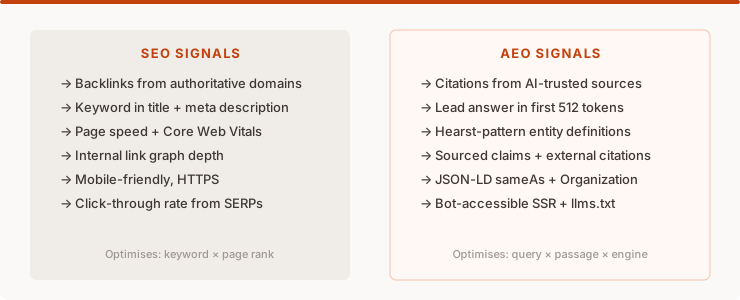
What changed between the PageRank era and the AI-search era?
Google PageRank era (2000–2024): the link graph was the authority signal. You ranked because authoritative pages linked to you. Tools optimised for it - keyword density, on-page SEO, backlink profile, anchor distribution, click-through rate. Google's own documentation on how Search works describes this as a crawl → index → rank pipeline anchored in PageRank.
AI-engine era (2024–): the citation graph is the authority signal. You're cited because authoritative sources (which an LLM-grade reader can extract from) talk about you in language that overlaps with how buyers ask questions. Different game. A 2023 study on Generative Engine Optimization by researchers at Princeton, UMass Amherst, and Georgia Tech found that adding statistics, quotations, and source citations to content increased brand visibility in AI-generated responses by up to 40%.
What are the six key differences between AEO and SEO?
The six differences are: (1) the unit of optimisation, (2) the signal of authority, (3) the query distribution, (4) the freshness expectation, (5) the metric, and (6) the fix. Each one is a different playbook, detailed below.
1. The unit of optimisation
SEO optimises a page for a keyword. AEO optimises a passage for a prompt. Cross-encoder rerankers truncate at ~512 tokens; your lede decides whether you survive the rerank stage. The page that ranks #1 in Google might be invisible in ChatGPT because the answer is buried at section 4.
2. The signal of authority
SEO authority = backlinks from authoritative domains. AEO authority = citations to the brand from authoritative sources, with consistent entity coherence (sameAs links, named-entity density, Hearst-pattern co-occurrence). A Wikipedia link is worth more than 100 blog backlinks because Wikipedia is what AI engines extract from at training and inference time.
3. The query distribution
SEO queries are keywords ("best CRM", "dentist near me"). AEO queries are questions ("what is the best CRM for a 5-person remote sales team", "is X-tool worth it for a startup"). The long tail moved into prompt-shape; AI engines collapse the head terms.
4. The freshness expectation
SEO indexing is days-to-weeks. AEO retrieval is live web search at inference time (ChatGPT search, Perplexity, Gemini grounding). A two-day-old blog post can outrank a five-year SEO winner if the AI engine's reranker thinks it's more relevant.
5. The metric
SEO metric: ranking position in SERPs. AEO metric: brand visibility percentage = (# prompts where AI engines mentioned your brand) / (# prompts run). Position no longer applies - there's no SERP, there's an answer.
6. The fix
SEO fixes are technical (page speed, meta tags, schema, link building) plus content. AEO fixes are mostly content + structural (lead-answer placement, Hearst patterns, entity coherence, sourced claims). The sourced-claim ratio matters more than the link graph.
Which parts of traditional SEO still matter?
Most of the technical surface is still required: HTTPS, mobile-friendly pages, schema, fast LCP, and a robots.txt that doesn't block by mistake. If Google can't crawl you, AI engines often can't either (they share the GPTBot/CCBot distinction but they all use traditional crawlers as a fallback).
What changes is the where of the optimisation work - toward content structure, citation earning, and entity coherence, away from link building and keyword density.
What CiteAgentic audits
CiteAgentic's scan consists of both audits. The SEO audit catches everything SEOptimer catches plus some they miss (DNS pack, tech-stack detection, dual-profile CWV). The AEO audit catches what no SEO tool measures (chunkability, lead-answer placement, retrieval signals, sourced-claim ratio). And the AEO monitoring product tracks brand visibility in actual AI engines, weekly.
Tools for the era you're optimising for, not the one you optimised for last decade.
See where you sit on the AEO scoreboard.
90 seconds, no credit card. The first scan is real, not a teaser.