Is the page itself written for AI engines to extract from?
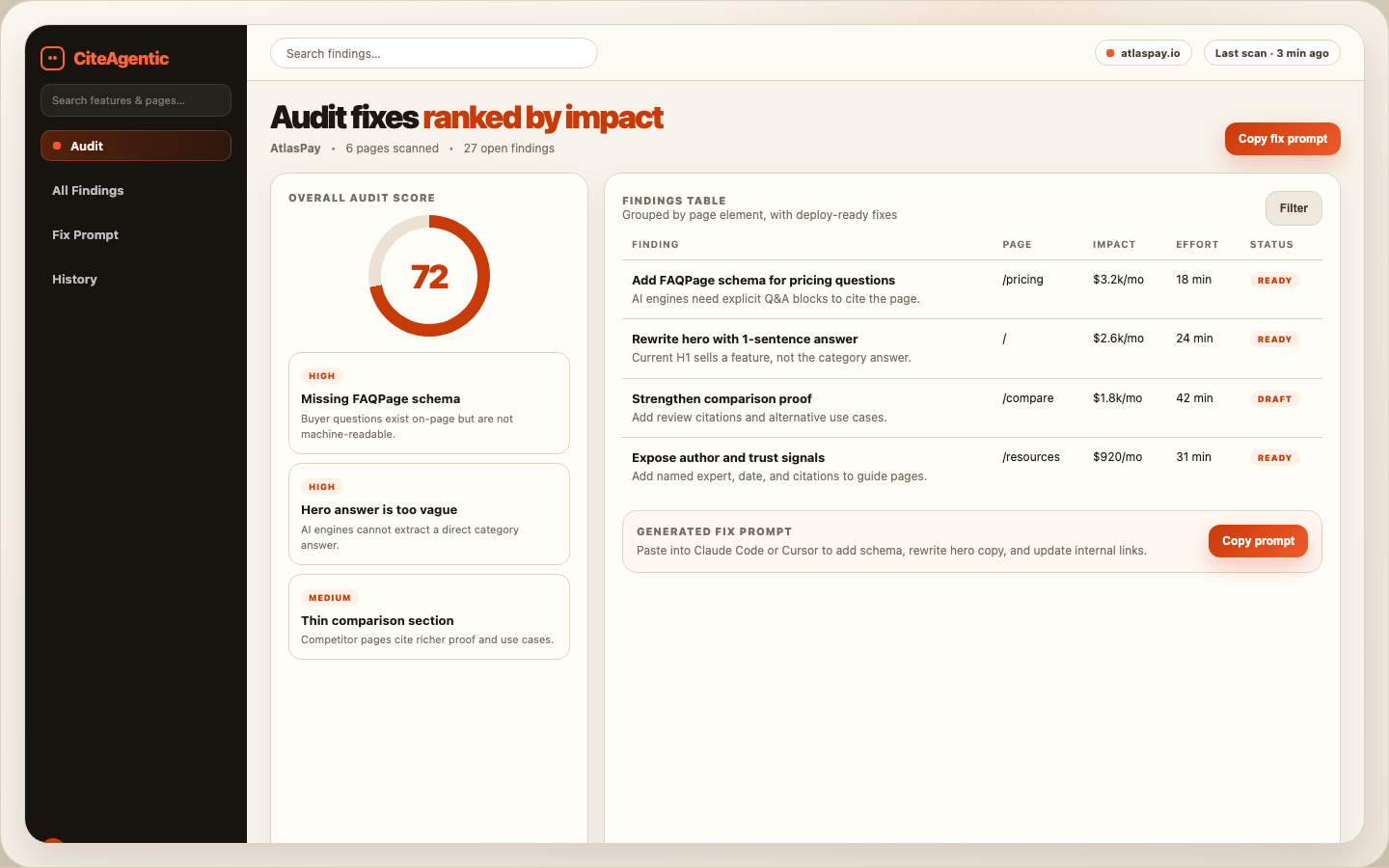
Tracking visibility tells you whether AI engines mention you. The page audit tells you why. 11 deterministic checks plus 4 LLM-driven checks for chunkability, lead-answer placement, Hearst patterns, retrieval signals, sourced-claim ratio, and entity coherence.
The 15 signals that decide whether AI engines extract from your page
Retrieval signals
First-512-token reranker target, lead-answer placement, title/H1 mismatch, question coverage. Cross-encoders truncate at ~512 tokens - your lede decides whether you survive.
Chunkability
Section sizing, anchor IDs on H2/H3 (Perplexity cites #fragment links), pronoun-without-antecedent traps, lead-sentence strength.
Hearst patterns
"X such as Y" / "X is a type of Y" - how AI engines extract category relationships from prose. Sourced-claim ratio for citation likelihood.
Entity coherence
sameAs links to authoritative IDs (Wikidata, LinkedIn, Crunchbase), Hearst-pattern density, brand-name consistency. AI engines disambiguate entities through these signals.
JSON-LD validation
Schema present? Author objects vs strings? FAQ thin? Body-schema mismatch (AI readers verify schema against the rendered DOM).
llms.txt + ?md negotiation
Bot-access rules for GPTBot / Perplexity / Claude / Anthropic. The "is your page even reachable by the AI engines you care about" check.
Every finding ships with a paste-ready AI fix prompt
The audit doesn't just tell you 'thin lead-answer'. It hands you a 1500-word AI prompt that tells Claude Code exactly how to rewrite the lede with the brand in the first 50 words and Hearst-style enumeration in the next 200.
Run the page audit on any brand. Free.
No credit card. Page audit is included on Free tier. Recommendations linkage to your tracked prompts - "fixing this audit finding will recover prompts X, Y, Z" - is Pro.